Product Support
- message us now
Message us now!

Choosing the right eartips for your In-Ear Monitors (IEMs) is often the most overlooked variable in personal audio. Even a flagship IEM driven by a high-end DAC will sound hollow and thin if paired with the wrong tips.

The eartip serves as an acoustic seal between the earphone driver and your ear canal, creating an enclosed air chamber.
The Physics of Bass (Acoustic Coupling): Low-frequency audio waves (sub-bass and mid-bass) rely on air compression within an airtight chamber to deliver tactile impact and full-bodied presence. If there is even a micro-gap in the seal, low-frequency air pressure escapes, resulting in a severe roll-off below 100 Hz.
Impact on Output Curves:
Incomplete Seal: Causes an immediate loss of low-end response (often dropping by 5–15 dB in the sub-bass region), making the sound signature thin, bright, and harsh.
Airtight Seal: Restores the intended baseline frequency curve, maintaining punchy sub-bass extension, lower-midrange warmth, and balanced treble response.
Severe Sub-Bass & Mid-Bass Collapse: Air leaks act as an acoustic high-pass filter. Low-frequency sound pressure escapes into the surrounding air, resulting in an immediate 6 dB to 15 dB+ drop below 100 Hz. The low end loses slam, sub-bass rumble, and physical impact.
Tonal Imbalance & Thin Presentation: Midrange and high frequencies are far less dependent on pressure seal than bass frequencies. When the low end escapes, the frequency response becomes unnaturally skewed toward the upper-mids and treble, leaving vocals and instruments sounding thin, metallic, or sibilant.
Hollow Soundstage & Poor Stereo Imaging: Air leakage introduces erratic phase shifts near the leakage cutoff frequency. This breaks center imaging coherence, flattens instrument separation, and ruins spatial placement.
Loss of Detail & Dynamic Range: Low-level nuances—especially subtle bass reverberations and spatial cues—are lost when acoustic coupling is compromised.
Compromised Passive Isolation: A broken seal allows ambient noise (environmental rumble, conversations, traffic) to pass directly into your ear canal, masking music details.
Auditory Fatigue & Hearing Risk: Listeners often compensate for missing bass energy and high ambient noise by cranking the volume higher, increasing the risk of Noise-Induced Hearing Loss (NIHL) and listening fatigue.
Instability & Slippage: A tip that doesn't seal properly often fits loosely in the canal, causing the IEM to shift out of place during walking, talking, or jaw movement.
The physical properties of the tip material dictate both acoustic behavior and physical isolation.
| Feature | Memory Foam Tips | Silicone Tips |
| Acoustic Behavior | Absorbs high-frequency reflections; smooths peaky treble and tames harsh sibilance for a warmer tone. | Preserves original treble extension, detail retrieval, and crisp dynamic transients. |
| Isolation | Superior passive noise isolation due to dense, expanding foam conforming to the canal. | Moderate to high isolation depending on wall thickness and seal quality. |
| Durability | Lower (foam breaks down over time from earwax and skin oils). | Very high (durable, washable, and long-lasting). |
Double (or triple) flange tips feature stacked silicone umbrellas designed for deeper ear canal insertion.
Deeper Seal: Reaches past the outer bend of the ear canal to secure an airtight lock where standard single-flange tips might slip.
Soundstage & Treble Impact: Deep insertion shortens the distance between the IEM nozzle and the eardrum, shifting resonant peaks higher up the frequency spectrum. This often yields tighter bass control, reduced high-frequency resonance, and enhanced imaging precision.
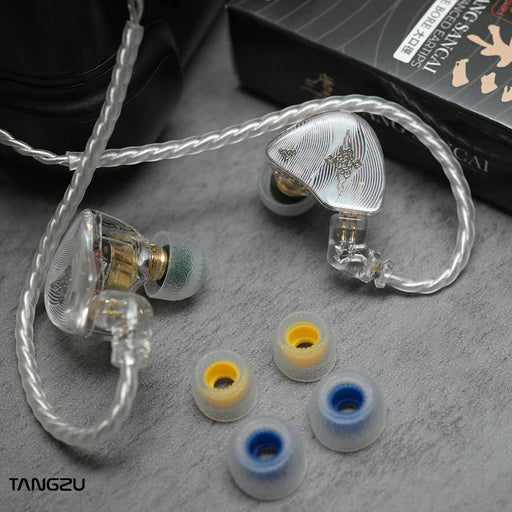
To fine-tune your IEMs, consider these popular options available at AEhifi (Click the photo to enter the product page!):
TANGZU Tang Sancai
(Narrow Bore): Features a textured matte surface that releases channel pressure while maintaining a secure fit. The narrow bore focuses low-end punch and tames harsh treble peaks.
(Wide Bore): Uses the same comfortable matte texture as the original Sancai, but with a widened exit aperture to maximize soundstage width, treble extension, and upper-midrange clarity.
(Balanced): The all-rounder option designed to maintain the IEM's stock sound signature while enhancing vocal clarity, natural timbre, and long-session comfort.